Should I Sign the Illinois Redistricting Petition?

Should I sign the Illinois Redistricting  Petitition? After listening to a discuss of this topic on WBEZ, I asked myself this question regarding this potential amendment to the Illinois Constitution. The truth is that this amendment is no panacea,  but it may increase political transparency and reduce partisanship.

Shady redistricting practices is not just a Chicago problem. The frustration with the current redistricting system is immense even in Southern Illinois where only 16.7% approve of the current system.

In the end, this amendment may not pass in November, but for now it should at least get enough signatures to get on the ballot.

Should we amend the Illinois redistricting process?

6 Things We Learned in 2013

With 2013 coming to a close, it is time to look back on a busy year for International Chicago.

February: US government data suggests that the US remains a huge CO2 emitter, especially when one looks per capita. As for Illinois, we are average in our polluting.

Copyright Andrew Levin 2013

April: Boeing Battled Back on Battery Bedevilments. The last word may be fake, but the problems were all to real for the revolutionary, but troubled Boeing-787.

May: Its really hard to fix Illinois’ massive budget woes. Nevertheless, it needs be done before Chicago becomes Crete.

June-September: My summer guide listed a great event for every type. My personal favorite was the Game of Drones Pub Quiz and found out that the more you know about international affairs/culture, the more you have to learn! I definitely recommend signing up early for Pub Quiz ‘14.

November: Over-the-air television became much more diverse with the introduction of a Native-American run and focused television channel on 20-2. Intelligent, informative and entertaining – this is yet another reason

All year: Illinois is the third biggest state in terms of agriculture exports, but its biggest export is machinery at over $20 billion annually. Oh and they really like us ‘Down Under, mate’.

2014: I wish all of my readers an amazing New Year. May it be filled with happiness and fewer international conflicts.

5 Chicago Gems on the South & West Sides

You may have heard about the French Foreign Ministry’s warning to French nationals to avoid the Chicago’s South and West sides. Well, the French government has removed its travel warnings, so there is no reason now to avoid some of Chicago’s most historical and beautiful tourist attractions. Here is just my Top 5 List:

1) Garfield Park Conservatory

This botanical garden is a beautiful park with green houses for more tropical flora. It has even been ranked one of the best urban green spaces in the country. Garfield is definitely worth a visit to the West Side.

Along the Boulevards. Source: Wikicommons, Andrew Jameson

2) Chicago’s Parks & Boulevards

Garfield Park Conservatory is off of one of the city’s broad boulevard that form a wide semi-circle around the city center. These roads have less traffic than the grand avenues of Paris so make sure to rent a bike to gain the full experience. I once spent a day biking the entire series of avenues: the beautiful homes, diverse cultural communities, and delicious cuisine show a facet of Chicago that is hard to find downtown.

3) Balzekas Museum of Lithuanian Culture

Like so many Chicagoans, Lithuanians immigrated for economic opportunities that were abundant in industry on the South side of the city. The museum discusses the history, culture, and arts that define this ethnic Chicago community and is emblematic of our welcoming nature.

Wikicommons, Fox69

4) Frank Lloyd Wright’s Home & Studio

While the home and studio of famous Prairie-style architect, Frank Lloyd Wright, is in Oak Park and not Chicago, this is but a formality. The location is only a mile from Chicago’s West Side and well worth a visit.

5) Midway Airport

That’s right. Chicago’s second largest airport runs between 55th & 63rd St. and Cicero Ave and Central Ave placing it in both the South & West sides of the city. It often has lower fares and is the only area airport for Southwest Airlines. Plus, this has quite a bit of history to it. It was the world’s busiest airport from 1929 to 1960 – a record length of time which never be broken.

So does this mean that I am advocating that the French should be waving around their smart phone at two o’clock in the morning on the South side? Of course not; however, no one should be doing this anyway whether it be in Bronzeville or Bordeaux, minuit or midi. Wherever you travel, be vigilant to protect yourself and get the best tourist experience!

The American Dream or Just DREAMing?

Mexico Looking North – Charles O’Rear

DREAMers, or children of undocumented immigrants, have entered the American lexicon over the last two years. Their stories are often of heartbreak – families torn about or themselves deported to countries where they may not even speak its language! But also of hope – they are often safer, healthier, and have a better education than they would have received in their “home” country.

As of late, these Americans are finally coming out of the shadows to make their stories and voices heard. So let’s hear their stories. One of my colleagues from graduate school has started up a Kickstarter (fundraising) campaign to create a documentary on the DREAMERs. If you are looking for a good clause, you’ve found it. You can watch the trailer and see the neat prizes for donating at: http://www.kickstarter.com/projects/196013859/indivisible-a-documentary .


UPDATE: Thanks to the contributions of over 200 people, the documentary reached its Kickstarter goal! I’ll make sure to give you all the details when it makes its way out to Chicago!


‘I want my Native Americans’?: Indigenous focused, run network premiers today in Chicago

‘I want my Native Americans’?: Indigenous focused, run network premiers today in Chicago

Starting today (November 1st), PBS station WYCC will host a Native American-focused channel, FNX, on 20-2. FNX which stands for First Nations Experience is an excellent addition to the WYCC channels which already feature one of the best sources of education and cultural diversity on television.

Chicago’s history was entirely that of Native Americans up until the end of the 18th century. Even the names of our fair city and state are derived from those original inhabitants. However, I believe the bigger positive is that we cannot forget that these First Nations continue on. Chicago’s urban tribal members are so rich and numerous that they are an integral feature of a permanent exhibit of the Smithsonian’s National Museum of the American Indian. It is very necessary that we do not ignore these original Americans – especially as we might not even know who they are as we pass them in Oglevie or on Rush Street!

Several programming highlights caught my eye. The first is a documentary called “Dakota 38”. Generally unknown to the general population, 38 Dakota Indians were hanged in 1862 in the largest mass execution in American History. Rather than focusing on the execution itself, the program focuses on a group of Native Americans today who want to raise awareness about the drugs and violence that are being perpetrated by their own people by taking a pilgrimage on horseback to site of the execution. Also of interest is “Fish out of Water” which teaches non-Native Americans traditional skills.

India’s new boom: Grandma?

From time to time, I bring to your attention to books that hit chords with the global trends and local challenges. Deborah Moggach’s book, “The Best Exotic Marigold Hotel” brings together a fictional tale that addresses the conundrum of aging in a globalized economy.

In Bangalore, India’s Marigold Hotel plays host to about 2 dozen English senior citizens. Part of the larger trend towards cheaper foreign living, these elders have abandoned (or more accurately, been abandoned by) the society of their birth in order to afford to live in dignity during the waning years. The author goes into the stories of mismanaged retirement funds, of ghettofication of inner cities, and the loss of significant others as reasons for these traveling grandmas. But underneath almost all these stories is the dearth of assistance from their children. It makes you wonder about the role of the extended family in the West, especially when compared to the very connected Indian characters’. Admittedly, the sad stories get a bit melodramatic, but I have no reason to believe that such stories are unrealistic.

Perhaps the most noteworthy aspect of the book is Moggach’s ability to give voice to the elderly and the dying process. On the one hand, the hotel is part of, in the words of one of the Indian characters, the beginning of a new Indian economic boom: human beings. Now, humans are willingly turned into commodities in search of that dream of retirement. What a concept! In supposed welfare states, elderly individuals don’t have enough to retire.

It really brings home the way that the elderly in America are in even worse shape. Think of all the baby boomers who are delaying retirement or forced back into the workforce due to the recession’s very negative effect of defined contribution pensions (401k, IRAs, etc.). While social security and medicare are a great help, the number of LINK recipients I run into on any weekday at Aldi show a more unfortunately version of aging. Plus, the recent shutdown is starting to threatened Meals on Wheels – one of the most pivotal programs in protecting the dignity of the elderly. What, if anything, do we owe, our elders? It is an important question to ask since most people my age and younger are very hesitant to expect much of anything. Whether this is unwarranted cynicism or pragmatism is unclear.

On a more positive note, Moggach also manages to give true depth to the customers of the Marigold hotel. Even as these seniors are commodified, their visions of themselves, their needs, and their desires come alive in throughout the novel. At one point, Indian call center employees visit the hotel to learn more about their “home”, England. The whole experience shows a strong desire to not only reminisce on an England that appears to only exist in their little hotel but to interact, teach, and learn from others. The complexities of the elderly is definitely a sphere that is too often overlooked in literature – falling into simple-minded grandmas and altruistic mentors.

Finally, I think one element of the story that we must be cognizant of is the geographic components. First, all the major characters are either Indian from near Bangalore or from England. Bangalore, once the “Garden City” is now a technology center of the country and is highly central to the renaissance of India internationally. In addition, England of course is the part of Great Britain where London is located. However, this part of the country has changed the most in recent decades. While other regions’ (Scotland, Wales, and Northern Ireland) devolutions of political power and renaissance of cultures have led to regional pride, English pride has been largely limited to soccer holigans and racist groups. England is home to both massive economic success in parts of London and widespread economic recession in other areas of the region.

A Reason for Hope in Mali

With the inauguration of a democratically-elected leader, Ibrahim Boubacar Keita, Mali may finally jetison the uncertainty and violence of the last 18 months.

Challenges Remain

Despite this positive move, Keita has a lot of work to do. Many Malians remain internally displaced, for the underlying Tuareg separatist movement is still kicking. In addition, corruption remains widespread. The risk of kleptocracy is real and dangerous to this fragile democracy.

Luckily, Keita isn’t going into the fight alone. Earlier this summer, the international community pledged over $4 billion in reconstruction aid.

So, what do you think lies ahead for this Western African country?

Should There Be A Travel Advisory Against Chicago?

Through your Facebook network or media articles, you may have come across the website, HowSafeisMexico.com . The website which is not openly credited to a specific author, provides a number of statistics that generally show that much of Mexico is very safe and open for business and tourism (as long as you use common sense in big cities and avoid certain areas of Northern Mexico that have been hard hit by the drug trade). The website claims to have utilized government, media, and consultant sources of information.

A few statistics really stood out, and the critical thinker in me decided to put these ‘wow factor’ statistics to the test.

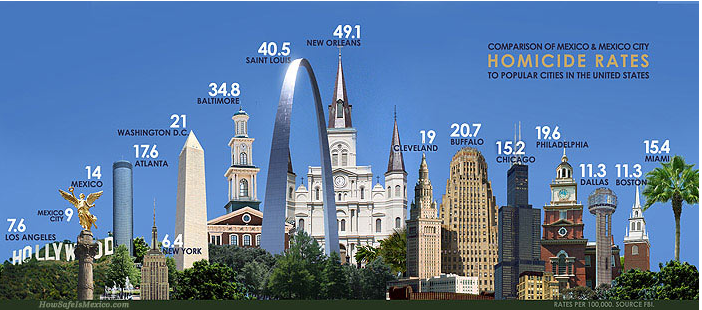
Probably most pertinent to us here in Chicago was its graph comparing Mexico’s homicide rate to that of American cities including our own.

Comparative Homicide Rates

If this graph is accurate it should be New Orleans, Saint Louis, and perhaps even Chicago deserve travel advisories rather than our southern neighbor. So I went ahead and looked into this infographic. Initially, I was unable to find evidence of the FBI statistics matching their own. For example, Chicago’s regional rate is only 6.8 homicides per hundred thousand inhabitant in 2011 the final year with finalized data – less than half the rate quoted by the Mexican promotion site.

However, then I realized the issue; instead of looking at the region, I had to calculate the city proper. So I took the 431 homicides in 2011 divided by the 2.7 million residents and found that in that case the rate was sadly slightly higher than the one quoted on the site! Still worse was New Orleans which had 23.7 homicides per hundred thousand residents in 2011.

OK so the site is accurate or even conservative in their estimate for American cities, but this was only half of their analysis. Nowhere on the FBI site did I find statistics on foreign countries’ crime rates. Through Mexican government statistics, I found their country’s rate per hundred thousand inhabitants was 24 in 2011. This places it around that of Brazil but below the rate of Honduras or New Orleans for that matter.

While these statistics aren’t gospel, I do praise the site for helping give perspective to the whole situation. Like Mexico, Chicago is at risk of injuring its brand if it is simply seen as a hub of murder and muggings. As someone who has taught after school on the South Side and conducted program evaluation on the West Side, I can tell you that life goes on outside the glitzy Miracle Mile. Oh and if you are going to use statistics at your guide, New Orleans is definitely that place avoid. That and don’t be a male over 15.

Going Global Chicago-style

A joint project of the Brookings Institute and JPMorgan Chase analyzed what makes cities relatively global and recently produced a report. The writing describes “the 10 traits of globally fluent metro areas.” Globally fluent as  far as I can tell means that the city matters. It tells other cities what to do and can only be bullied around by a select few of its colleagues. So here’s what it said (and did not say) about International Chicago.

Your’s truly read through the report and found a lot of globally fluent traits right here in Chicago. Firstly, seeming appropriate for the Second City, the report found us a “second-tier global city”. But before you get too upset, this places us in the same tier as Hong Kong and Singapore. Thus, we are as influential as at least one country! 

Chicago reached this level during the eighties and nineties alongside a quixiotic mix of Barcelona, Seattle, Sydney, and Tel Aviv. They contrasted Chicago’s progress with poor Milwaukee and Buffalo who “lost” their global fluency. Furthermore, the city’s rise was not as Geographer Jan Nijman put it due to “unplanned occurrence.” Unlike Miami’s relative luck, the City of Big Shoulders remained true to its name fighting hard for its economic, financial, and trade might. To me this seemed to be a little to kind to our city and too mean to Miami. Behind both was geography, and while Miami may not have encouraged some of its expansion of influence (just look at how ridiculously bad customs is at their airport), the state is a beacon of low taxes (Tiger Woods) and scurting legal norms found elsewhere in America (OJ Simpson). 

Finally, the study goes over the pros & cons of global fluency in Chicago. The metro area is “America’s most internationally significant non-coastal region.” Along those same lines, you have to give credit to where its due, Mayor Daley. His international efforts were unparralleled. While most cities now offer Chinese and Arabic, he was one of the first. He went abroad frequently to drum up trade and picked winners such as China. 

Yet, it was not all good news: transportation. While above average in access to public transportation, commutes are quite long even compared to equally populated cities. The report found only 24% of jobs in the region could be reached by public transit in less than 90 minutes. 

The two words I never saw: Poaching & Corruption

This generally glowing view of Chicago is very true, yet I still worry about the future role it will play internationally. This is for two reasons poaching economic strength and corruption.

The first is poaching jobs. While Governor Quinn was down in Mexico promoting trade with Illinois, Texas officials were hear advertising the benefits of their state AND the governor of California was in China promoting trade with his state. The pie of world GDP isn’t growing like it used to. When you only have a certain number of slices, you have to steal the economic and trade strength from others. In and of itself, I believe this would be just fine under the leadership of a Mayor who was not up to his ears in domestic in-fighting. Strength and political solidarity is just the business climate to be invested in. 

Yet, the widespread corruption of the state is the bigger problem for Chicago. When my Elections class had Congressman Walsh speak last fall, he noted that the state was the laughing stock in Washington due to its mismanagement. Whether this was true only his conservative circles or throughout, the result is the same: a branding disaster. There is a reason that US’s own development group the Millenium Challenge Corporation will not assist any developing country with too high a level of corruption – its perceived bad for business.


The Nation of Maybe Next Time

You don’t have to be a politico or even mildly observant to know that June has been a politics-overload. The Supreme Court provided grist for the mill on everything from the role of race in college admissions to effectively ending the pre-clearance process for voting changes. They also gave the right to states to decide the issue of gay marriage. Meanwhile in those states politics was no less exciting either.   

 Yet, what struck me was how routine Americans were about the whole process. Of course, decisions and bills brought special interests to their feet and their twitter feed: crying foul, celebrating, or even both. There was always a sense of continuity. 


Maybe Next Time…

 The “maybe next time” thought process that we in America take for granted is essential in the flourishing of a full, rich democracy. Without it countries become but a shell being a played in a game three card monty. You might think you found the one with the values underneath but probably not. These delegative democracies are perhaps even more common than ones with rules that matter and principles that last. In Angola, elections are called at irregular intervals with less than a month’s notice, so opposition candidates don’t stand a chance. In Burma, so highly praised in foreign press, a military junta still rules with an unpredictable iron fist. As for the big up and comers, the BRICS, each has high levels of corruption and/or nepotism that would send Americans into conniptions.

The United States not only holds fair elections – plenty of notice, lots of rules (usually following), and normally two viable candidates – but is governed under so many regulations and rules. Strange as this may sound, this actually a good thing!

 The Supreme Courts decisions rarely reach the level of Brown v. Board; they usually plot results into the “maybes under certain circumstances” category. As for states, even where large majorities represent a particularly party, there are ways of skirting, adjusting, and fighting back. I still remember around 2002 when Colorful Colorado played unexpected refuge to Texas Democrats. Despite millions upon millions of liberal supporters in the state, Republicans controlled a near supermajority in the state legislature, and they wanted more still. They designed a new Congressional districting map that was so incredibly self-serving and antithetical to free and fair elections that they placed themselves on the verge of one-party rule. Utilizing Robert’s Rules, Texas Democratic legislators realized their best response was to leave. Outside the Lone Star state, the legislature’s Republicans could not reach quorum and approve the bill. 

I saw echoes of this minority spirit in the filibuster of Wendy…. Fired up against a bill to greatly limit a woman’s right to choose, the filibuster went on for 10 hours until she was finally stopped through a procedural vote. Despite the politicians’ best efforts, the crowd’s cheers then carried the meeting past its midnight deadline. The special session officially over, the legislation had been avoided at least for now. LIke in so many occasions, though, our fundamental nature gives those who disagree a “maybe next time”. Vocal battles are better than wars and far less costly.  


And Yet Something Still Troubles Me…

While legislatures may make an imperfect venue to debate controversial issues, judicial review within the Supreme Court lacks the same amount of legitimacy. In many democracies (most based off of the United Kingdom) parliamentary sovereignty holds that all laws passed by the legislature are therefore constitutional. The US Judiciary is a very important element of checks and balances, for we didn’t exactly have much faith in directly following the flexible framework of our former imperial overlords. However, remember that for every Brown v. Board, there are many repugnant rulings: Dred Scott decision, Plessy v. Ferguson, Korematsu v. US and Bush v. Gore.  Bottom Line: The Supreme Court should take a much smaller role in overturning the will of the people.