Creating “Museums” to Promote Student Research & Analysis Skills

I have the privilege of speaking at tomorrow’s conference of the Illinois Council for the Social Studies (ICSS). The topic is the (Social) Science Fair. Growing up, we almost all took part in at least one science fair. You choose a question and then you research the subject and determine an answer to it based on your evidence. My thought was that my US History classes could apply many of the same concepts. After all, science fairs are just a way in science of applying the larger pedagogy of project-based learning. Thus, I created quarterly “Museums.”

They museums address specific major topics in history and allow the students to dig deeper into a specific topic of particular interest to them individually. Not only does this allow them a voice and a choice in what they research, but also it provides great opportunities for them to perfect their research and analysis skills.  The end result are displays that allow students ask questions and learn from each other’s expertise.

If you are heading out to the Quad Cities for the conference, please consider attending my interactive talk at 8:30am in B-2118. I will guide you through lesson planning and make suggestions from my experiences. If you can’t make the conference, then please check out my museum worksheets and a checklist for teachers. As always, please let me know your thoughts of my work.

Finally, I wanted to thank Willowbrook High School”s Social Studies Department for their tremendous support.

Creating Engaged Citizens at Willowbrook

Embed from Getty Images

Since August, I have been teaching at Willowbrook High School in the Western suburbs. It is a dream job. Not only do I get to teach US History, Economics, and US Government at a great school, but also I get to teach these subjects at the third most diverse school district in the entire state. This diversity presents many opportunities to engage the classroom and work in varied points of view. It also encourages bringing in historical perspectives of underrepresented groups – a part of the new Illinois Learning Standards for the Social Studies. Every day, I wake up excited to help my students become more knowledgeable citizen scholars.

Outside the classroom, I am the sponsor for Interact (the high school branch for Rotary International). This has been a great experience – it has allowed me to reconnect with Rotary. The students have led several projects so far, including a book drive for a library in Africa, a video game tournament that raised nearly $300 for fighting polio, and an outreach campaign against domestic violence. If you are available please stop by Chipotle on March 15th and mention our club. Fifty percent of all proceeds will go towards a refugee and displaced migrants charity that the students chose.

Mais, Oui: Adding French to My License

new-map-francophone_worldI am excited to announce the addition of French to my teaching license, which means I am now able to teach the language in the state of Illinois. Along with my social studies, math, and special education endorsements, I am now fully prepared to engage students with their world.

Readers of the blog make sure to pass on any leads to help me find my “boulot” for the upcoming school year! My email address can be found under “About”.

Mind Mapping “No Pity”

If you decide to read “No Pity”, then these mind maps of chapters will come in very handy.

From Claudia A. is the Mind Map for Chapter 2

From Xenia R. is the Mind Map for Chapter 7:MindMap Chapter 7


“No Pity” Bookmark

Serafina N. had the wonderful idea of a bookmark for “No Pity”. It is a Word file so that you can add or change it for your class’ needs and interests.

SPE 506- _No Pity_ Representation

“No Pity” Helpful Links

Riley H. Recommends:

Nightlife Interview – https://www.youtube.com/watch?v=jxLC0_qTYVw

Deaf Mosaic – https://www.youtube.com/watch?v=OtsYVeRuBuw


Celebrating Deaf Culture and Civil Rights

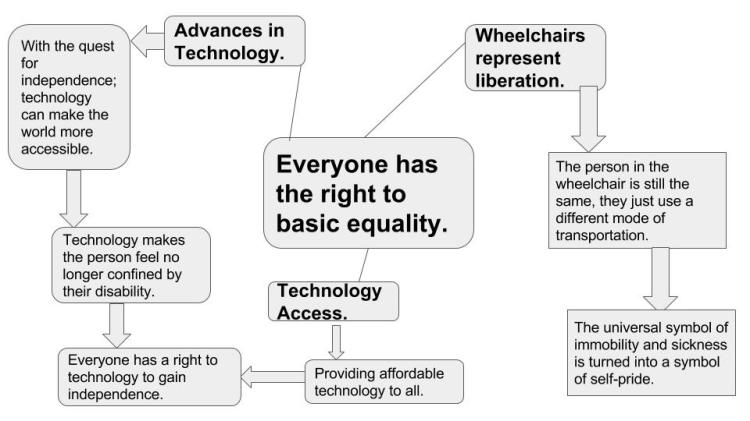
As the Americans with Disability Act (ADA) reaches its 25th anniversary, my group in special education read “No Pity” by Joseph Shapiro. The book charts the course of the Disability Civil Rights movement at its height. It also inspired us to create a series of important projects that we would like to share with the general public. While no replacement for the book, it is a great resource. Below is a Deaf Culture and Civil Right Webquest that any Civics teachers is welcome to use in their classroom. For a pdf version, just email me.


Deaf Culture & Civil Rights History Webquest

Designed by Andrew Levin, ahlevin@gmail.com


The 1988 protest by deaf students at Gallaudet University was defining moment for the disability rights movement. It was the closest the movement has come to having a touchstone event, a Selma or a Stonewall…The Gallaudet campus takeover… was a made-for-television solidarity phenomenon, thick with drama. Cameras feasted on the sea of hundreds of outstretched arms signing “Deaf President Now,” over and over, in a rhythmic choreography. A school that prided itself on preparing deaf students for the hearing world had decreed a deaf person not ready to lead a deaf university.

-Joseph Shapiro, “No Pity”, page 74


As Mr. Shapiro points out, the student protests that successfully led to the first deaf president of Gallaudet were an extremely important step for Americans with disabilities. It emphasized a positive culture of disability and increased support for what would become the Americans with Disabilities Act (ADA). In this Webquest, we will learn some background on deaf Americans and about the event itself.


  1. http://www.disabilitymuseum.org/dhm/edu/essay.html?id=38

As hard as it might be to believe today, the first school for the deaf Americans did not open until 1817. What did deaf Americans do prior to this? What drove Mason Fitch Cogswell and Sylvester Gilbert to form the Connecticut Asylum for the Education and Instruction of Deaf and Dumb People? Would any words used in the school name be considered outdated or even offensive today?


  1. http://aam.govst.edu/projects/sdomas/imagetable.htm Alexander Graham Bell was a famous inventor in the 1800s. He was also hard of hearing. Take a look at primary documents from Bell’s life. What links can you find between his inventions and deaf culture?


  1. https://youtu.be/oxiJ02-hpZY

Helen Keller was both deaf and blind. Despite these conditions, she became a well-known and well-liked advocate for Americans with Disabilities. How did she learn to communicate? What were greatest achievements?


  1. http://www.gallaudet.edu/dpn-home/issues/week-of-dpn.html

This timeline of the Deaf President Now (DPN) protest give details of what happened each day during that week. In just eight days, students and their supporters changed Gallaudet University fundamentally. Read through the timeline, how did deaf American embrace their culture? How did they involve politics?


Continuing especially the epilogue. Which reasons seem most likely to be why this protest was so successful, so quickly?


  1. http://www.edline.net/pages/S/About_Us/Sabre_News_Network/Broadcast

Watch this local high school’s newscast. At 1:38, there is a segment called the “Sign of the Week”. Watch the clip and then decide whether such segments are a positive development of deaf Americans. Cite evidence for your answer.


Deaf Culture & Civil Rights History Webquest Exit Slip

How would you define Deaf Culture?


How would describe the Deaf Americans Civil Rights Movement to a friend?


Podcasts in the Classroom

Embed from Getty Images

While listening to the latest Freakonomics podcast (http://freakonomics.com/podcast/ask-not-what-your-podcast-can-do-for-you/), I was delighted to hear about efforts to personalize the education experience for high school students through that medium.

For those of you not yet in on the fun, podcasts are recordings that can be either streamed or downloaded. You can find podcast channels with segments on almost any topic from sports to politics to dating. Obviously for the classroom setting, students focus on their subject matter such as social studies or science. Given I LOVE the social studies, here are some of my favorites for newbies:

Freakonomics (Oddities of Economics)

Planet Money (NPR Personal Finance)

Toastmasters Podcast (Speaking Skills – occasionally hit or miss but usually good)

Under the Influence (Marketing)

Candidate Confessional (Political analysis of failed political campaigns by the politicians and advisers themselves)

We all have students in class who are constantly fiddling with the cell phones or want to put in their ear buds – by incorporating podcasts, these classes adapt to student habits. But more importantly, education becomes personalized. Each student can listen to a different (teacher-approved) podcast that fits their interests. By making the learning differentiated and relevant to students, the result is a more authentic learning experience. For example, while studying Campaigns and Elections in Civics, students can choose a podcast segment from Candidate Confessional and understand how one politician’s experience relates to the facts in the textbook. It will make it more real, this has shown an increase on their grades and learning experience so we offer them once in a few podcasts to do an interactive one, in which they can talk about personalized topics as sports, events happening in the week and like last podcast, topic was referring to online games as we found out there are a lot of gamers at school and students loved the insight of knowing something extra like learn about services by professional gamers or which types of consoles and which games are the most popular right now, it’s little break in the studying matter and helps them to expand their minds and to get more interested in the podcast experience.

Once I earn my professional teaching license this Spring, I look forward to bringing this technology to my own high school classroom in the Fall. Having already designed a course curriculum at Harper College, I know how to plan and collaborate with my department and the administration to bring innovative ideas into the classroom. As such, I would be able to bring podcasts into classes such as US Civics. There is always something of interest to each student and this tool can help us educators find those ways to engage every single young adult.

Aristolte and American Democracy

Embed from Getty Images

There is a great upcoming event at the National Hellenic Museum on January 28th. “Greek Philosophers, Founding Fathers, and American Law” will address how our government and its laws have been influenced by Greek classical thought, especially Aristotle. The event is free for students and you can sign up at the link above.

Teaching: The Year in Review

Embed from Getty Images

Four years ago this month I began teaching. This past year was the most successful and intellectually engaging year yet.

It began in January with my teaching evaluation process at Harper College. I decided to improve Diversity, Inclusiveness, and Inequality Education (DIIE) in my classes. Throughout Spring courses, I provided a short survey to students after each class. This anonymous, optional survey about how well the sessions had addressed diversity, inclusiveness, and inequality. After a few weeks of results, I implemented course improvements to further engage diverse students in authentic, relevant learning.

I prepared my success stories from my research and presented them at the Annual Conference of the American Political Science Association (APSA). I got to spend my Labor Day weekend presenting a lecture and a poster presentation on diversity and inclusion in political science. The conference attendees raised even more interesting teaching suggestions that I have since added my classes such as a unit on the political struggles and successes of Americans with Disabilities.

Following Spring semester, I headed out west to Salt Lake to grade AP US Government exams. Three thousand essays later, I know exactly how this exam is graded. Yesterday, I was honored with another invite for this year’s grading cycle.

The rest of the summer was spent teaching an online version of Non-Western Comparative Politics. When not teaching, I designed a powerpoint and a test bank for a new American Government textbook coming out next year. I am also publishing a book review in the Journal of Political Science Education in 2016.

Finally, I am beginning the next phase in my education career by becoming a secondary  education teacher. In September, while continuing to teach at Harper, I began a one year masters and certification program in social studies education at National Louis University. I have already passed endorsements in political science, history and mathematics and plan to complete additional endorsements in economics and special education (LBS1). So far the courses have been illuminating and provided me with great strategies for students with disabilities and diverse students in general. I was also able to observe teachers at Fremd High School, Hoffman Estates High School, and Baker Demonstration School. Thank you to those at all three schools for opening your doors to this young teacher. In the new year, I look forward to bringing all my experiences and newfound knowledge into a high school classroom. I will also get to continue to mentor other educators in my new role as Region 1 Representative for the Illinois Council for the Social Studies.