Three Trends to Watch in ’13

http://en.wikipedia.org/wiki/File:US_President_Barack_Obama_taking_his_Oath_of_Office_-_2009Jan20.jpg

Thinking through the events of 2012 year, it was clear that a lot of events have occurred internationally. At home, President Barrack Obama was re-elected; though in the international sphere, candidate Mitt Romney had nearly identical policies. North Korea and Iran continue to be belligerent and reckless. Europeans may have reached the end of the beginning of the financial crisis (though the election of Francois Holland may not help France’s chances). China transitioned leadership, while continuing to cover up massive corruption throughout the entire Communist system. Meanwhile, both Japanese and Mexican voters went with conservative leaders from the party that ruled that country for decades. Syria took a low scale rebellion and turned it into a bloody civil war. Egyptians struggle with the challenges of democracy. In Latin America, Bolivia opened its sovereign debt to international markets and Chavez called it quits. In Canada, oil sands continue to be pumped to the US despite administration apprehensions on new pipelines. And right here in Chicago, we hosted the NATO conference with professionalism and grace.

So what does this all mean? I have identified three trends that you can expect see the results of in 2013.

First, 2012 was the year of ‘changing cultures.’ 2013 will be the year of personal responsibility. How can outrageously bad things happen so frequently when surrounded by so many good people? The consulate at Benghazi, Libya was constantly threatened with terrorist attacks. Despite calls from staff for additional security, the staff was forced to rely on local hired militiamen. The utter craziness of this dereliction of duty of multiple State Department bureaucrats manifested itself on September 11th. On that evening a group of terrorists approached the compound. It is not entirely clear whether those local hires simply ran away at the sight or actively assisted the terrorists, but the end result was tragically the same: 4 Americans including an American diplomat… were killed. A scathing report release just a few days ago listed multiple errors on behalf of the folks in Foggy Bottom, but it did not blame a single specific person, rather:

“Systemic failures and leadership and management deficiencies at senior levels within two bureaus of the State Department (the “Department”) resulted in a Special Mission security posture that was inadequate for Benghazi and grossly inadequate to deal with the attack that took place.”

Sadly, this is not limited to faraway lands. After the cover up of Jerry Sandusky’s abuse of children for decades at Penn State, the football program was allowed to continue to play after paying a fine. Only Sandusky paid any significant price for the actions – while no doubt countless people let this torture go on without personal responsibility. And I haven’t even gone into the banking sector that has been hit by scandal after scandal – billion dollars fees and losses!

Everything this year had to be systematic failures. There was a ‘culture of silence’ at State and Penn State – so they say. Yet, my gut tells me that politicians and the general public are both sick of it. Expect future scandals to be more or less handled as straight up criminal cases or, more likely, as good ol’ fashion witch hunt.

Jurisdictional Nonsense on the high seas: Here’s one heck of an international imbroglio, an Argentinean naval ship, Liberdad (‘Liberty’) was detained in Ghana by its government due to a court decision in the US. Why? Because the plaintiffs in America, NML Capital (a subsidiary of hedge fund giant Eliott Capital Management), said they were owed over $370M from Argentina’s default a decade ago. Rather than agreeing to a resolution of 30 cents on the dollar – they continue to pursue Argentina through the courts. In this case, they essentially held the ship ransom – $20 million for the vessel. The detention which nearly came to blows finally ended when a UN court ruled against the fund and demanded Ghana release the vessel.

Look for more use of courts getting engaged in politics including in tertiary countries. Not all the debtors are so excited about ECB debt actions for Greece. Will the holdouts take their own Liberdads? Also, keep an eye on Palestine. Newly recognized by the United Nations but weak at home, pursuing (or deciding not to pursue) UN court cases against Israeli leaders might be their ace in the hole.

And finally watch out for the Sahel…

Copyright Andrew Levin 2012

The next terrorist hot bed: I have been watching with great dismay the fall of Mali. Twice this past year, the government was overthrown in a coup d’états. Worse yet, the first coup in March was just weeks before a legitimate democratic election. Worst, the chaos and incompetence of the strong men have led to the loss territorial control of the entire north of the country to the Tauregs. This has just added to the instability in the region with Mauritania (the black sheep of the region) on one side and large-scale terrorist attacks by Boko Haram just down the road in Nigeria. This area has the potential of going much farther south very quickly. Like any contagion, this disorder is want to spread and the next country that will be affected is Burkina Faso. This author has traveled extensively in West Africa, and his experiences do not bode well for its chances. While the Burkinabe people are very warm, they are run by the autocratic Blaise Compaoré. Civil society is nearly non-existent, and less than 20% voted in the President’s last sham election.  Hope for the best but expect trouble in the Sahel. The UN has already authorized an African force. The good money is on military advisors from Africom as well heading that way in the new year before the region becomes a new Taliban Afghanistan (complete with sharia law).

Happy New Year to everyone and expect some great blog entries soon on gun control something close to every Chicagoan’s heart: gun control.
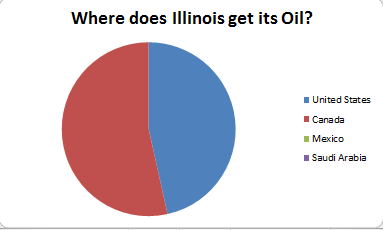
What do you know about your tank of gas? (The answers are here!)

Last week I put up this poll asking where our oil comes for here in Chicago? Thanks to the monthly data on imports, I can now report that the majority of Illinois’ petroleum comes from our neighbors to the north: Canada. Congratulations to the forty percent of you who got this one right!

But those who chose US were very close.

Nevertheless, I myself had guessed the US would be number one. As it turns out several pipelines have been built in recent years linking the Alberta Tar Sands with local refineries in Joliet and Whiting, Indiana. Only a few years ago, the picture would have been much different. At that time, most oil came from the Gulf States. Now, so much oil is flowing south that for the first time pipelines are being reconfigured to continue the flow of crude oil to southern states!

Technically referred to as “heavy crude oil”, our Canadian oil is more challenging to refine. Traditional refineries can only process a minimal amount of heavy crude oil at a time. As a result, BP is currently upgrading its refinery in Whiting. After completion, the facility will be able to process far greater amounts of tar sands oil. Supposedly this will not lead to additional pollution. Given BP’s recent $4 billion criminal conviction, I am not holding my breath.

Truth is, however, that the writing is on the wall for this one. Canada is a stable democracy that is very close geographically. From an energy security perspective, the case for expanded use of Canadian oil is huge. Like any rose, this one has some major thorns. The extraction process is both more harmful to the environment and more detrimental in terms of carbon emissions. Converting tar sands into even heavy crude is an intense process. It also is destroying the largely indigenous First Nations’ way of life in the region. Like always the answer is the same – drive less in the short-run and hope alternative sources of fuel are developed soon!

Vote Yes on the IL Constitutional Amendment

In short: This amendment will make it more difficult for legislators to turn Illinois into Greece. The Amendment will deter any further growth in unfunded future liabilities from direct benefit pensions and other benefits to public employees. Finally for those in public service (including myself) let me make clear that it will NOT affect current pension promises.

Longer version:

Traditionally, workers in government and most of the private sector did not need to plan for their retirement. They were members of professionally managed funds call direct benefit pensions (DB pensions). Their benefits upon retiring were defined by their plan based of their final salary, rather than how much they contributed during their career. This worked fine during the roaring fifties and sixties as stocks rose at an average of 8% annually.

Then almost as bad as the rise of disco, the 1970s brought recessions. In fact, much of the 1970s, 1980s, and early 1990s were marked by economic stagnation, and those great returns on stocks and bonds fell sharply. Nevertheless, pension accountants continued to project unrealistically high returns (called discount rates) throughout this period. This practice continues on to today. So the state kept promising large pension payments to workers long after they became unrealistic.

Enter Unfunded Future Liabilities:

They promised these workers certain benefits, EVEN though these workers were not investing enough, and ALSO EVEN though it was clear the stock market wasn’t performing as projected. Just as credit card debt adds up really quickly once you fall behind, state debt does the same exact thing. It is largely for this reason (along with paying medical benefits to retirees) that the state is in debt. It has to keep paying those benefits even as it goes further into the red. Already it is tied for the lowest credit rating of any state. This only worsens the situation as they must pay higher interest rates on their debt than any other state (even California pays less to finance its debt).

So you ask, does this end direct benefit pensions in Illinois?

No.

The private sector largely abandoned DB pensions for all new employees by the mid-1990s. Even the Federal government eliminated the traditional pension. This is neither the end of direct benefit pensions nor even the beginning of the end – however, just maybe it is the end of the beginning. It is a first (small) step towards fiscal responsibility.

This past spring legislators voted for this referendum to the Illinois Constitution in a rare bipartisan fashion. Most legislators including Speaker Madigan and President of the Senate Cullerton signed on. It says that future pension increases must be approved by 3/5 of each Illinois assembly. Furthermore, it will require

The Big Picture: The Bontemps lasted for quite a while in Illinois but they must come to end. To be clear, this referendum does nothing to fix our current jam. This a Churchillian situation where we are not seeing the end, nor the beginning of the end, but perhaps passage of this legislation will be the end of the beginning. This is a first step towards the sort of fiscal discipline that everyone is averse to.

However, the consequences are far too high to vote no. The road Illinois is currently on is either to Greece or the Northern Mariana Islands. In a Greek scenario, outlandishly high spending relative to pension contributions will lead to years of austerity budgets that will slash pension benefits and several hurt retirees who had been expecting larger payments. Believe it or not but the Northern Mariana Islands scenario might be even worse. The pension there is attempting to file bankruptcy. If it is successful, it could immediately cut its payments. Pensioners might receive half or even less of their promised benefits!

As a public employee, I understand the desire for a secure future. Continuing pension benefit increases will not, so vote yes.

Chicago’s Thai Celebration

Last Friday, downtown workers were treated to free massages, tasty delicacies, and unique vendors as part of the Thai consulate’s festival! Here are some great pictures from the event.

Here is a fruit carver which is apparently a traditional art. Such delicacy and care on such a temporal canvas reminds me of the Fluids Happening at Northwestern University a few months back by MacArthur Fellow and Brazilian artist Iñigo Manglano-Ovalle. The detail here is quite amazing and must require a lot of talent! I meant to ask if these works were simply meant for decoration or were supposed to be eaten. Do any of readers know?

My favorite was of this vendor from Boonrod Treasures. She told me that her family had originally made wooden flowers in Thailand. When they came to Chicago, they continued the tradition. Now these flowers are made in Chicago. She was nice enough to take a picture with her art. I could not help but purchase a few for my wife!

QE3: Money for Nothing (and the Chicks for Free)

Chicago School Teachers entered the second week on strike following disagreements over a medley of education issues. As a result average Chicagoans have been frantically searching for safe alternative daycare. And to make matters worse our beloved Bears fell short up in Green Bay. Chicago has been busy. Yet from the Beltway came a Fed decision that deserves closer scrutiny as it will affect nearly everyone: QE3

Quantitative Easing or QE entered its third (possibly fourth, if you count Operation twist) round this past week. Under this move by the Federal Reserve, America’s government bank, the Fed will start buying Mortgage-Backed Securities. Unlike previous QEs, this will not be a single large purchase. Rather the Fed is committing to continue buying US securities until macroeconomic conditions improve. By setting an expectation of continued buying, the Fed hopes to encourage institutional investors to get out of low-yield US Treasuries (think that Treasury Bond that your grandma used to give) and into more risky investments such as loans for small businesses and mortgages.

In such a conservative bank environment, many question whether QE3 will have any positive effects. Rates are already hovering right near zero and that constitutes a lower bound. Hence my title’s reference to the Dire Straits song. In the video, a bunch of Joe the Plumber sort of characters are describing how rock stars do not do any hard work and still get lots of money and “the chicks for free.” Warning the video does contain some NAFW language. The Fed moves are too often seen by day traders as sacrosanct, and there is usually a corresponding rise in the stock values. However in the end, the Fed’s activism is being tempered by fundamental underlying issues that are not being addressed.

First and foremost is that the financial system relies on far too few pillars of support. A recent scandal in London may not have made headlines but it greatly affected the average American. Libor is a rate of interest that many loans are pegged to (i.e. Libor + 200 points). It is voted on by a small group of private bankers. Not so shockingly it appears that some of these leading bankers used to their positions to manipulate the rate to their advantage. Our entirely economy relies on the actions of bankers in New York and London. This in part exemplifies why Congress tried in Dodd-Frank to make “Too Big To Fail” a relic of the past. However, the legislation has had a small effect so far in part because it was filled with unrelated nonsense: outlawing conflict minerals in American manufacturing is a worthy aim but in a financial services bill?! Nor has the international community greatly reduced the risk of overly heavy borrowing. Failed firm Lehman Brothers would have likely passed the Basel III conditions.

Secondly, the Euro question remains a major challenge. Many countries such as Spain and Italy have massive debts. In the past they would have diminished the value of their currency, but a united euro makes this strategy impossible. ECB bond buying will have to continue indefinitely if this method is to secure the community. The decision by the European Central Bank to buy bonds is perhaps part of the reason for the Fed’s use of QE3. Globally, this might act as a sort of united front against default and recession.

Finally, the Fed’s decision is not without an understanding of its political environment. Congress spent last week passing its final major bill before the election. By sending out this controversial signal at a time when Congressmen are preoccupied the Fed is unlikely have much oversight. In addition, most institutional investors are waiting until the elections. This action might have a least force them into the market and increased short-term liquidity.

What does it mean to you? If you are a saver, your job is going to get even harder. With bank accounts interest well below one percent you are literally losing ground against 1.7% inflation! On the other hand, those looking with stellar credit can expect to find great loan and mortgage rates for years to come. However, be aware that those with ok credit will remain in trouble. Unless QE3 ends up saving the day, non-FHA mortgages will remain out of reach of most people. Worst of all, foreign affairs such as turbulence in the Middle East or Iran could easily over power the buying.

Help a College Class Learn about Political Polling!

Please take the short linked poll. It was designed by my advanced Elections class at Harper College (with some guidance). Next Wednesday, the class will analyze the results!

https://docs.google.com/spreadsheet/viewform?formkey=dFNuZDJuOHA0MDlveldCSUI5R0ttZEE6MQ

The Poor Penniless Penny

What is America’s obsession with the penny? Quoting a study from 1976, the US Mint suggested that the humble penny is the “most widely used denomination in circulation.” Even more bizarre, the one cent coin  requires nearly 2.5 cents in raw materials. A penny saved is now a penny and half of your tax dollars down the drain. As the 2011 Annual Report points out, making pennies cost the US Mint 60.2 million last year alone. Nor is this a new problem. In 1982, pennies went from heavily copper to largely zinc to reduce costs. However, higher zinc prices and the diminishing power of the dollar have sparked this trend anew. While the Obama administration debates a more thrifty penny alchemy (anyone for steelies?), the best solution is to reduce or even eliminate the nearly worthless coin. It would not only save costs but may also jump start America’s mobile payment industry.

The penny is one of the smallest value coins in the developed world. Living in Senegal, I very rarely encountered coins below 25 francs (about five cents). However according the Central Bank of West Africa, their coins start as small as one franc or about a fifth of a cent. These coins make more sense in West Africa where purchasing power is far greater for similar services. The I took the bus downtown for a total of 20 cents: a similar trip on the El would be an order of magnitude larger. Developed countries require larger coinage and several have already stopped minting their versions of the penny:

Australia 

Norway

Switzerland

United Kingdom

Even our Canadian neighbors have decided to call an end to their penny, and their production was far less burdensome (though still unprofitable) than our own.

Finally, the world is turning towards payment systems that don’t require coins at all. While many have long used checks, credit cards, and debit cards, forms of mobile payment (cell phone-based payments for small purchases) are gaining traction. Currently, the US is less active in this arena compared to much of the developing world (South Africa, Kenya, and the Phillipines are particularly active). Having a larger market at home among the unbanked would nudge American companies towards this growing field – providing jobs and tax dollars along the way. Soon everyone would have a penny-free alternative for every transaction. While choice is preferable, spending millions of taxpayer dollars each year is certainly a valid concern, and when combined with the potential of helping American industry, the choice is clear. Drop the penny.

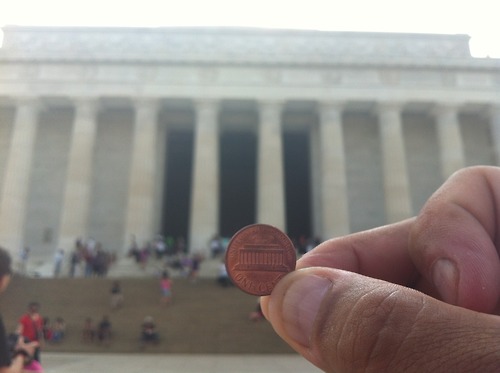
For you Lincoln buffs, remember that removing the penny will not end the use of Abraham’s visage on American currency. Just take a look at any five dollar bill! As an added benefit, such bills cost only 8 cents to produce!

The (Unresolved) Clash of Cultures: What Peru can learned from the “Party Politics” of Wounded Knee

Wounded Knee: Party Politics and the Road to an American Tragedy

Like so many geographic names, the origin of the word “Chicago” is Native American. These first Chicagoans named the area: “shikaakwa” or “Stinky Onion.” Not the most ostentatious of names, but a very accurate description of the plant life that continues to line the banks of our waterways. With a bit of francophone transliteration, the name Chicago was formed. Despite the abundance of names influenced by the languages and cultures of the First Nations, we as a country have yet to truly own up to the level of disenfranchisement required to build the Manifest Destiny that we continue to exploit to this day.

Heather Cox Richardson’s  Wounded Knee takes us back to the mid- to late-1800s to explore the economic and political machinations of the government and big business’ quest to subdue the Sioux Indian tribes and open up their former lands to ‘progress.’ More specifically, the Richardson argues that origins of the Massacre of Wounded Knee lie thousands of miles to the East which at the time was in the throws of crony capitalism.

The temporary Civil War measure of high tariffs to protect the Union’s military-industrial complex, later became THE permanent pillar of the Republican party. Richardson argues logically that these taxes on imported goods helped what we might now refer to as the 1%, Eastern industrialists that headed monopolistic trusts, while hurting the purchasing power of just about everyone else. As Republicans who controlled Congress and the White House for almost the entire quarter century after the War continued to raise ever higher tarriff rates, the inconvenience turned to an onerous burden upon Western farmers who were already straddled by underwater mortgages. At same time, President Harrison (elected in 1889) made ever more obviously corrupt patronage that led to gerrymandering the Census for political gain, the expansion of the White House to house his entire extended family, and literally starving Indians on the Reservations due to ineptitude and mismanagement.

By 1890, many Republicans in the West began deserting the party in droves for the newly formed farmers’ alliances. Unlike the recent Tea Party Movement, the Alliance movement decided not to try to influence the party from within but to act as viable, separate party. In the midterm elections that year, they were very successful – capturing many state and local offices and Nader ’00-ing the Republican vote in several other key elections. As a result, the elite decided to bring back their base through the oldest trick in book: FEAR.

At this point, the book begins to lose some of its strong steam. Fear of the other (the Sioux back then, non-“family values” or alternatively “big business” today) can be a particularly effective tool for ensuring party member support. However, despite calling the military to the West under weak pretenses, there is still not a clear reason why economic realities and a poorly managed Bureau of Indian Affairs would lead to a massacre. When a clan was asked by US soldiers to disarm at Wounded Knee Creek, a small skirmish turned into an unmitigated slaughter. Unarmed Sioux women and children were chased down and shot as far away as two miles from the incident. Disgusting as it may be, it’s also worth remembering that soldiers cared very little about the victims. Cox does decently explaining the economics and East Coast politics that set the stage for this low point in American history. However, we must ask what mindset led relatively average Americans to commit these atrocities? At the core, it was a feeling of inferiority of these proud Native Americans.

One look at Peru shows that this is not idle speculation but essential to figuring out how indigenous nations will or will not be protected in the 21st century. It took nearly a hundred years before the Sioux were allowed to once again practice their religious beliefs such as the Sun Dance and other cultural traditions. Even now, the area remains one of the most depressed in the country. Will indigenous Peruvians get a better shot at their form of prosperity?

Following the roads and development of multinational gas companies into the Amazon, average Peruvians (like their Brazilian neighbors) are heading into the homelands of tribes that have rarely been contacted. The native peoples’ remoteness had been their savior preventing the tragedies and subjugation felt by American tribes over a hundred years ago. BUT, that time is over. Despite Lima’s assurances, just like Cox’s understanding of American politics, today’s Peru is following a similar, potentially devastating path – more unauthorized incursions increase the likelihood of both disease and massacres.

So what is the solution? It begins with bringing action from the words of universal human rights. These norms installed after the atrocities of the second World War are essential to empowering these groups and the international humanitarian community that fight on their behalf. Secondly, the United States, Canada, Australia, and New Zealand should join every country in the world by signing the Declaration on the Rights of Indigenous Peoples. If indigenous peoples end up being forced into this unknown world, they should at least have the international community fighting for their traditions and rights. Finally, many of the main gas companies should try harder to prevent other Peruvians from unauthorized use of their infrastructure. Two American companies with large financial stakes in a new pipeline in the region are Conduit Capital Partners and Energy Transfer Partners. Tell these companies how you feel and that you want to ensure their cooperation in responsible business in Peru.


Where Should We Plant the Canadian Flag?

The Supreme Court just confirmed the constitutionality of the Patient Protection and Affordable Care Act’s (PPACA) individual mandate. This provision requires all uninsured Americans to enroll in health insurance or pay a tax penalty. For those who could not afford insurance, the Act was also to expand Medicaid. This second provision was adjusted but not struck down by the Court, because I haven’t thoroughly digested these details, I will leave this provision out of my analysis. As you probably recall, the Act’s history was a tortured one – it was meant to allow all Americans to obtain health insurance. However, the White House was forced to make compromises among both its moderates in Congress and with Senator Scott Brown, a Republican who unexpectedly won Ted Kennedy’s former seat and thus imploded the Democratic super-majority in the branch.

So we are well on our way to becoming another Canadian health care system, right?  First, lets define what is Canadian healthcare. The system is single: the government manages care. It acts as the insurer describing when and how Canadians can receive treatments. This can lead to far less paperwork, but sometimes specialists and elective surgeries require long waits. It also negotiates lower bulk rates for pharmaceutical products.

Where the is the most similarity between systems is in the emergency department. Since President Ronald Reagan signed the Federal Emergency Medical Treatment and Labor Act (EMTALA) in 1986, American hospital emergency rooms have been required to assess and treat emergencies regardless of insurance coverage or ability to pay. Nowhere in the initial nurse-proctored assessment does an American get asked non-health related questions. The initial assessment then determines the wait. Similarly in Canada, the more severe the patient’s ailments, the shorter the wait, and vice versa. However, the similarities end once patients have been stabilized. At this point, money becomes a factor in entirely different ways. In Canada, there is an incentive for doctors to solve the underlying conditions – as this will lead to lower recidivism. In America, the point is to remove those who don’t pay as quickly as possible – federal payments for uninsured patients tend to be much lower than actual costs.

Yes, PPACA clearly expands the role of the federal government in healthcare, but it’s no copy of the Canadian system. Private insurers are and will remain the central element of healthcare. If you have insurance, you will likely see little change. I myself benefited by being able to continue under my parents’ plan until I turned 26. Also, pre-existing conditions can no longer be used against you like a battering ram.

If you don’t have health insurance, do not expect any Canadian-style entitlement. No more will healthy people be allowed to save money by not buying healthcare – they will be paying a private insurer upfront or the federal government on their tax return. But many will probably choose the tax penalty. When I was between jobs and bought the most-inexpensive (and least useful for anything short of catastrophic calamities) insurance, it was still about $45 per month. For a young person switching between unpaid internships and job applications this is not insignificant. We are talking an opportunity cost of at least one hundred Chipotle burritos each year – or one hundred and fifty Portillos hot dogs (if you prefer).  Given tax season is long after the year is over, many young people will need quite a whopper of a penalty to consider switching their behaviors. In the longer term, its possible changing attitudes may reduce these tax payers.

Nevertheless, if these taxes are used wisely by the government to prevent diabetes, lower infant mortality, and improve early detection of Cancer and heart disease, there might be a positive externality that might reduce the reasons that many uninsured go to emergency rooms to begin with.

To recap: 

The US is not becoming an insurance company

Healthcare prices will continue to rise

Short of a huge tax penalty, a large number of healthy people will continue to remain uninsured

This compromise of idealism and pragmatism, rooted in the separation of powers, is very American

Canada, this is not. 

Rio Redbull, Now at Macy’s

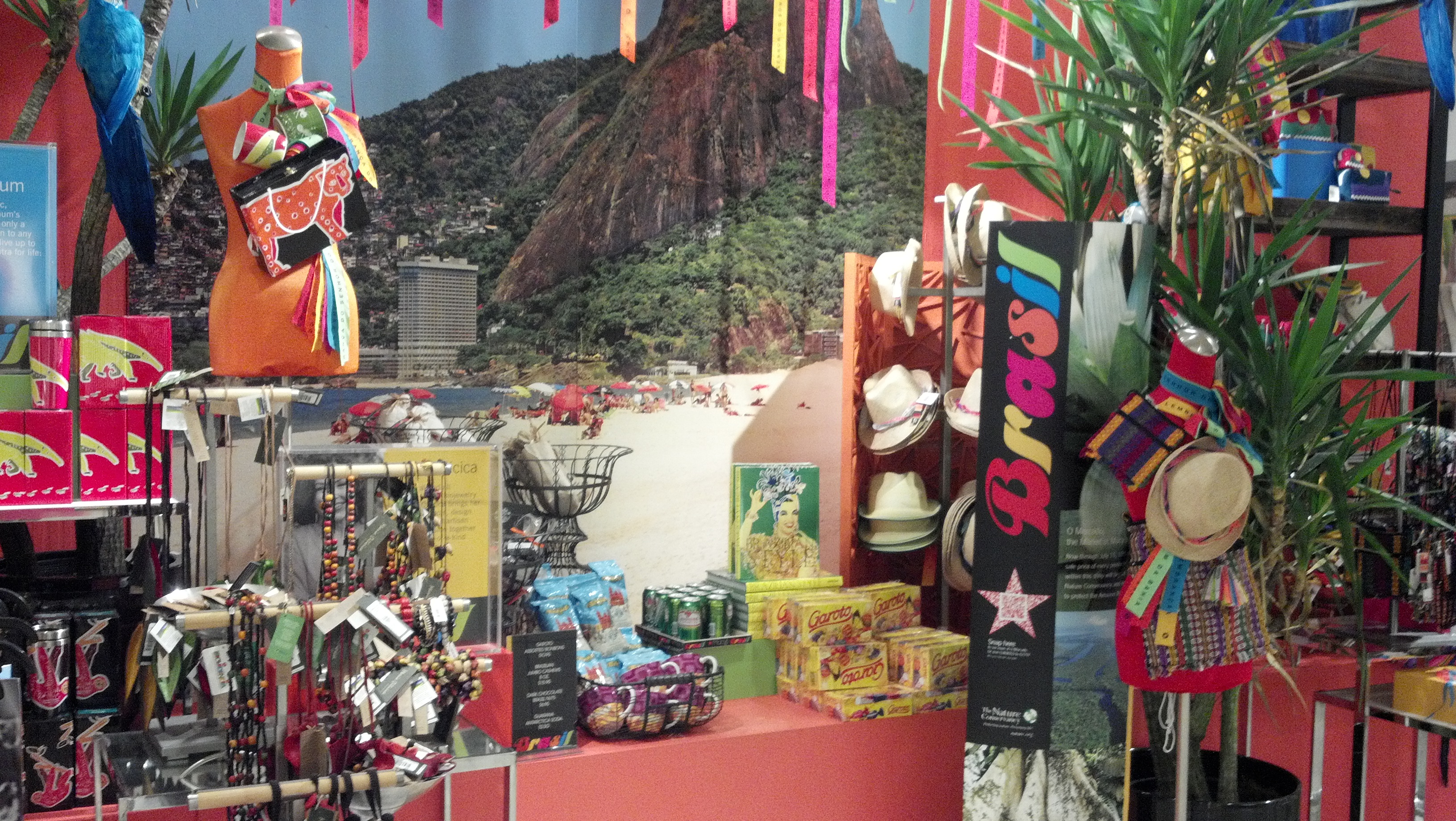
As part of Macy’s “Brasil” summer marketing campaign, the former Marshall Fields superstore has added some fun extras to their usual inventory. In addition to Brazilian themed clothes, there are music CDs with killer beats (my personal favorite song was not there), snacks, and even a soda from our southern neighbors, Guarana Antarctica.  According to sales associates, the Brazilian-made pop has become quite a hot ticket item. They have been literally jumping off the shelves. Most sales have been casual consumers; however, one customer bought over a dozen.

How could I not give the beverage a try?

First, I looked at the ingredients: water, sugar (not much corn down there), and Guarana extract. “Where had I heard the name before?”, I pondered. Then it hit me this was the same extract that helps some energy drinks wake up folks around the world. Cool, this was truly a Rio Redbull! I popped open the can and took a sip.

The verdict: pretty good. Guarana Antarctica’s flavor is very reminiscent of a watermelon jolly rancher. I was particularly impressed with its sweetness – enough to pucker the lips but not the whole bag. Try it for yourself. It is located by the escalators of the downtown superstore. But if you can’t make it downtown, keep an eye out for it at your local supermarket. PepsiCo recently bought the worldwide distribution rights – so far they have only exported the brand to the Iberian Peninsula.