Lessons for Wisconsin from the Southern Tiger

I have introduced a new section to the site that is devoted to book reviews. Like everything else on GlobalChicago, the focus is on books that contain both a local element and an international joie de vie. The first book is The Southern Tiger an autobiography of former Chilean anti-Pinochet activist turned president, Ricardo Lagos. It is a natural fit for this theme: Chile was during the 1970s and 1980s a natural experiment of University of Chicago-based ideas of neoliberal economic policies (explained further in the blog). Furthermore, post-Pinochet Chile has established a fairly equitable relationship with the United States based on trade, migration, and exchange of ideas.

Nevertheless, I think the lessons learned from Chile’s experience reach far beyond the developing world. Across our northern border, Wisconsin is an absolute uproar. Their governor, Scott Walker, is about to undergo a recall vote as a consequence of his efforts to take away bargaining power from the state’s public unions. As this country is too often want to do, the government and the unions have both taken diametrically opposed views. Our jump to extremes in this country is antithetical to the cooperative, almost friendly manner in which the political parties worked  in Chile towards building a brighter future for their country. We as a the country must learn to be pragmatic above politics. Even parties that continued to support Pinochet into the early ’90s, worked with the coalition with Lagos to rewrite their Constitution. We must give common sense a try as name calling has led to nothing but acrimony. Lagos was from the socialist party. Yes his book makes clear that he cares deeply about social welfare. Yet, despite being a ‘socialist’, he successfully completed more free trade agreements than President Bush or Reagan. We have nothing to fear in bipartisanship except success, relevance, and professionalism.

Chicago NATO Summit Success: Inside and Out

The Chicago NATO Summit is over. The leaders of over fifty countries have left for home. However, this event has left an indelible mark on NATO and the city itself.

Inside the halls of McCormick Place, a clearer security picture of Afghanistan came into view. We already knew a few things. Washington has long said that it expects to remove the last American combat troops by 2014. On Friday, President Holland reaffirm that French engagement in ISAF would end by year’s end. What was less certain preconference was how Afghan Security Forces would fit into the picture. NATO has officially decided to place Afghans in charge of most security functions by mid-2013. A year of continued ISAF involvement should allow time to mentor and further education the Afghan military and police. Hopefully, this may allow more American soldiers to return prior to 2014.

Challenges remain in the details and politics. Funding will not be cheap: about $4 billion per year. Facing budget cuts, will Western nations really have the commitment to pay Afghan policemen over domestic needs? Moreover, Kabul remains very corrupt under President Hamid Karzai. Will Afghan civilians themselves trust Afghan forces or respect their authority over those of local mullahs? It is, however, a necessary step to ensure the long-term stability of the Afghan regime.

Opening up Pakistan to NATO supply lines continues is also a work in progress.  Despite an invitation to the Summit and a talk with President Obama (albeit brief), Prime Minister Asif Ali Zardari has not opened up these routes. Without these routes, NATO has had expand their Northern supply routes through at least four former Soviet Union countries and Russia. It is more expensive. Moving troops out of Afghanistan through those routes will take longer too.  To understand their hesitancy, think about it from Pakistan’s perspective. They have been burned by the US before. They were a close buddy of the US during the eighties only to be shunned by Congress as soon as our involvement in Afghanistan ended. They see America as an unsteady ally, so they want to extract as much of a toll as possible before the exit. Despite rhetoric regarding an apology for the accidental bombing of Pakistanis, it really comes down to money. Negotiations continue.

Outside the red zone, the public is very positive regarding the city’s management of the Summit. “The City that Works” emblazons the cover of the Chicago Sun-Times. Pieces of paper thanking Chicago police are taped to poles downtown. The city of Chicago was even lauded by President Obama at the end of the conference. Chicago police were diligent yet generally passive: arrests were in the dozens not hundreds. Intelligence was vital in infiltrating the protest movement and stopping the most dangerous before the Summit began. Behind the scenes the host committee led by Lori Healey proved that Chicago can welcome the world with safety and style.Other than a few professional protesters, most agree that the Chicago of gangsters and Dem ’68 is gone for good.

This is not to discount the concerns of the thousands of peaceful protesters (who formed the vast majority). While NATO and NGOs are spending great sums on education in Afghanistan, many were asking for a more just and equitable society here at home. Admittedly, NATO has next to nothing to do with Wall Street or banks. It is not an economic forum. Still, the continued presence of the Occupy Movement suggests that young people remain disappointed with America’s handling of domestic issues. Foreign funding may well get much more criticized in the coming years as our soldiers return. It could be that their messages would get much more media attention in Chicago than at the G8 conference in rural Maryland.

NATO Highlights Day One

NATO Secretary General Anders Fogh Rasmussen spoke with the media following the Summit’s first meeting of the heads of state.

Syria: “NATO has no intention to intervene in Syria.” We must assume then that NATO believes that Kofi Annan’s less than 300 monitors can manage a ceasefire in a country almost as large as Texas! Turkey must feel a bit insecure with a such a lackluster response!

Smart Defense: Air Policing will be done by Western powers, while Baltic states work on ground forces.

Missile Defense: “We will continue our dialogue with Russia.” Missile Defense planning continues. Joint Threat Analysis would be appreciated regarding Iran. He felt that an analysis would show Russia that they too might face a threat from Iran.

Military Budget Reductions: US continues to commit “to a strong Atlantic Alliance.” In process of “making more efficient usage of our forces.” Also, reduced agencies from 14 to 3!  NATO is “a multinational solution” to budget issues.

Afghan Security Forces Aid after 2014: “This summit is not a pledging conference.” Nevertheless, recent commitments make him “optimistic” that they will be able to find “around 4 billion US Dollars.” Later in his speech he talked about needing to raise 4 billion euros/year. Optimism aside, this goal seemed pulled right out of the air. This may explain his slip up between USD and euros.

NATO Updates

Afghanistan is definitely going to be the big issue for the Chicago NATO Summit. The new president of France Francois Holland announced to President Obama that he would be removing French troops by the end of 2012. While this is not a big deal in terms of troop contributions, it is ever more important to ensure that aid continues from the West for years to come. As discussed in my previous blog, there is still a huge need to build the Afghan police forces and the rule of law. Without this, we may leave the country susceptible to a more media-savy, but equal horrible Taliban. It will severely hurt the average Afghan.

Furthermore, leaders from both Afghanistan and Pakistan will be present at the Summit. With no middle man, communication must be straightforward. You can bet President Karzai will not accept idle talk – real aid commitments will be the engine of the economy for years to come.

Also of note, the Italian leadership has left early in the wake of a large quake in Bologna.

Finally, let me know if you have any photos from inside the red zone or outside.

NATO’s Here and Yes This is Great News!

Chicago: America’s Barcelona

I want to address an issue I am hearing a lot about. I believe this NATO conference can make a huge impact on Chicago’s tourism and development.

This is something I have studied for a long time. As an undergraduate at Northwestern, I wrote my political science honors thesis on mega-events. Admittedly, NATO is smaller but if anything this makes the cost-benefit analysis much more positive. Instead of building world class velodromes and mountain biking trails in ghettos and garbage dumps (the NYC2012 really proposed these), Chicago can get away with building zero infrastructure.

While security is not free, the security is necessary exactly because there will be over fifty of the most important people in the world all in one place, here. These leaders are not isolated individuals – their pictures from the summit will be showcased on the news back in their home countries. Assuming the Emanuel administration is good a schmoozing, they will at the same time show these leaders all the best of Chicago: the Art Institute, the skyscrappers, and of course the Lake. The result is clear. When leaders return home, they will note their surprise at how wonderful Chicago is to all their friends and businessmen.

This would not be the first time a city with little international presence has made a big splash through a mega-event. Barcelona was a no name second city of Spain. It was overshadowed by Paris, Rome, and domestically by Madrid. Yet by hosting the Olympics, it overnight became an international destination on the maps of global tourists. Its hard to imagine what if any following a non-Olympic Barcelona would have had outside of strong soccer fans. Business is harder to quantify, but having a recognized name cannot hurt.

On the other hand, mega-events do not necessarily lead to large positive gains. Pittsburgh hosted a G8 Summit a few years ago. As far I am aware this has not led to large growth in tourism or business.

So here is the question I pose to you: Are we a Barcelona or a Pittsburgh of the world?

Judging by the name of my blog, you can be sure what my answer will be to the question. Even more importantly, a recently WGN Poll found that nearly 60% of Chicagoans agree hosting this summit will improve our international standing. We have nothing to lose from this summit but our negative image, or in many countries our lack of an image entirely. Let the images of Capone and Convention ’68 fade behind images of art, culture, business, and trade next to the Lake.

Barring a large negative event, Chicago will come out a big winner in the long-term.

In other NATO news…

Led by the Stanley Foundation, a recent conference addressed a wide-range of topics associated with international policy: the upcoming Chicago NATO Summit, G-8 conferences, and European Debt Crisis. The conference received additional support from the Buffett Center of Northwestern and the Global Summitry Project at the University of Toronto.

It was a great conference, and I am happy to report those who were unavailable can now watch all the highlights as the Foundation has made available a number of videos. My personal favorites include this one on the G8’s efforts against WMDs and this one on the future of NATO (I love Professor Ahmet Kasim Han’s maps of the world – from Atlantic Centric to Pacific Centric – notice how Europe ends up at the edges)

Also take a look at the Stanley Foundation’s just released a presummit policy memo!  It truly addresses the complexities of summits and why so many social scientists study the phenomenon.

The Facebook of NATO

Thanks to an anonymous underpaid staffer at the Sun-Times, we now have a great facebook of the leaders coming to the NATO Summit this Saturday.

Did you know Zeljko Komsic, President of Bosnia and Herzegovina, has an average monthly net salary of just $550?

How about that Ilham Aliyev, President of Azerbaijan, has his photograph shown at the end of the movie, “Borat?” Also, he apparently likes aubergine purple taxis.

Or that M. President Francois Hollande of France’s former partner and mother of his four children is Segolene Royal (she was lost to Nicholas Sarkozy in the last election)!

Sadly, leaders from Bulgaria, the Czech Republic, and Lithuania were not interesting enough to deserve a “Fun Fact!”

On a serious note, people matter. We often think about multilateral negotiations as a massive processes of thousands of bureaucrats over many months. This is true. However, once these summits commence, the specific individuals will determine success or failure. NATO is a consensus-based organization. One no vote is the same as 28!

Hundreds of Somalis complete military training: Heading home to boost the forces fighting Al Shabaab.

Great article on what will hopefully be just the first trained Somali troops going back to fight Al Shabab.

Hundreds of Somalis complete military training: Heading home to boost the forces fighting Al Shabaab..

Chicago a Global Powerhouse

Chicago is second only to New York among American cities according to measures of ‘Global Clout‘. This according to a recent index based on cities’ results to five surveys related to global city power. This places it ahead of more populous Los Angeles! It is also ahead of Washington, DC, perhaps the world’s greatest hub for international policy creation. This is a bit surprising – but why criticize the result when it’s so good 🙂 .

Chicago also recently ranked 6th in the world according to a study in the Atlantic Magazine. Paris (5) better watch out – with a new socialist president – they may find themselves behind Chicago next year!

International Challenges, Local Solutions: Cook County Combats Human Trafficking

Hundreds of girls are kidnapped. Often they endure intense pain and humiliation as they are branded like animals. The abuse only gets worse. They are soon sent out into the street to become child prostitutes. On the rare occasion that local authorities do find out about this modern-day slavery, it is almost always the child prostitute who gets arrested. The pimps and Johns rarely face any consequences.

If these horrors sound like something that could only happen in some far away land, sadly you are very wrong.

I recently attended a conference entitled, “The Dark Side of Global Trade: Human Trafficking from the World to Chicago.” The event part of Georgetown’s John Carroll weekend brought together alumni from my masters’ in Foreign Service (MSFS) program (as well as other interested alums) to discuss what Cook County is doing to address human-trafficking in Chicago.

It began with an introduction on the global trade by former Ambassador to Combat Human Trafficking, Dr. Mark Lagon. He explained that human trafficking takes many forms globally:  prostitution disadvantaged castes and bonded laborers in India, domestic servitude, and even child soldiers in the Congo. The general definition is that these are people are who are treated as subhuman and exploited.

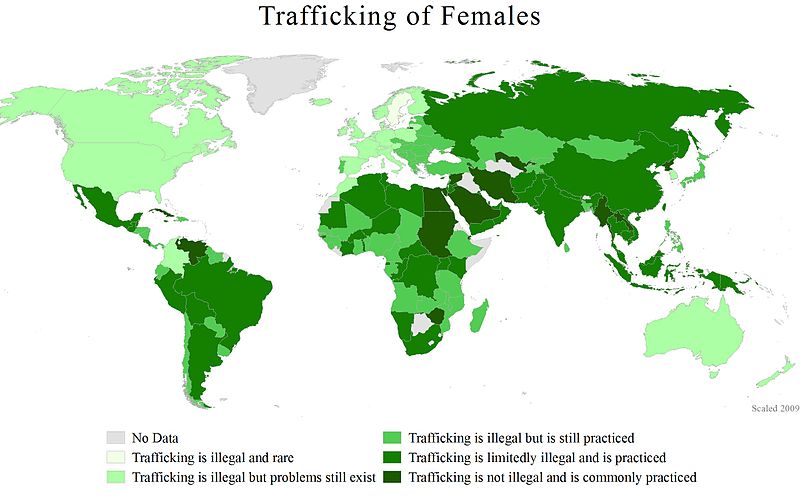
Worldwide there are an estimated 27 million victims! While 2/3 of these trafficked individuals are in South and Southeast Asia, this is truly a global problem. In response most countries have signed the Palermo Protocol which committed these states to the elimination of all forms of trafficking.

However, “the problem is implementation,” Dr. Lagon explained. Local politics and national priorities don’t always match up. Even when they do, implementation requires a thousand local officials to adjust laws and even attitudes.  Enter, Anita Alvarez, then newly elected Cook County State’s Attorney.

Ms. Alvarez immediately encountered a major problem. As other illegal activities such as drug trafficking began to become more challenging due to law enforcement, Chicago gangs were increasingly turning human trafficking. Amazingly, this was far less risky. In general, the gangs would kidnap young women and traffic them to Chicago for prostitution. Hundreds of girls were forced to the Windy City from across the Midwest (human trafficking is often not international). Yet, the police were of no help to the children since statutes at the time called for the prostitute’s arrest. “Children would be charged with child prostitution and end up back in the arms of the pimp,” Alvarez explained.

Prostitution Often Begins Before Adulthood

So here first effort was to change these unjust laws. The office successfully lobbied the Illinois legislator to rewrite the Illinois Safe Children’s Act. The act revisions pushed Cook County into the right direction:

Firstly, no longer would juvenile prostitution be a crime. Ms. Alvarez has since set up a special court to address the social services of prostitutes.

Secondly, it gave law enforcement the ability to wiretap suspected pimps.

Finally, it raised fines for John and allowed them at times to impound their vehicles.

But this was only a start to anti-trafficking efforts. Using a federal grant, a Human Trafficking Taskforce was made that combined the efforts of multiple agencies. It includes both local and federal ones.

Using the revised law and combined resources, Cook County conducted an operation which has so far led to the arrest of 59 traffickers.

Nevertheless, when one audience member asked about labor trafficking, Ms. Alvarez admitted, “still a lot of work needs to be done.” There have been no non-prostitution labor trafficking arrests. Chatting with others after the lecture, it started to become clear. Though I know of no surveys on the subject, most audience member believed that general labor trafficking was of non-regular migrants (or as more commonly known, illegal immigrants). Therein lies one of the biggest challenges of any international policy implementation – changing attitudes. Ending one form of human trafficking, child prostitution faced a receptive public. For very good reason, civil society, law enforcement and politicians are all committed to ending this prostitution. And as a result, Chicago has become a leader in these laudable efforts.

Sadly helping other labor trafficking victims that might be here illegally stirs up controversy.  Until attitudes change, and this type of trafficking faces more pressure, full compliance with the Palermo Protocol is a long ways off.

To learn more about ending prostitution in Illinois please visit End Demand at http://www.enddemandillinois.org/

Albright: “Summits Very Important” and The Search of the “Right International Institution”

Courtesy of Harec on Wikipedia

A great excerpt from former Secretary of State Madeleine Albright (and one of my favorite professors at Georgetown) speaking in Chicago about the NATO Conference! Generally, her comments align with my recent NATO Primer. Dr. Albright reiterates the importance of the Summit as a “glue” to keep countries looking towards a “common purpose” in what is a very busy election year (US, France, UK possibly).

She does make a great point regarding how negotiations are conducted at summits. The main sessions will include all NATO members as well as “Friends of NATO.” So we are talking about up to fifty heads of state in one room! Thus, she notes that many negotiations will be taking place in ad-hoc bilateral meetings. Finally, she admits that there is little faith in NATO and other international institutions – everyone is looking for the “right international institution.”  Hopefully, this summit will be a step towards a more purposeful NATO!

http://www.youtube.com/watch?v=msqRNp7yXh4 (Don’t worry its only 5 minutes!)